Junctional buckling
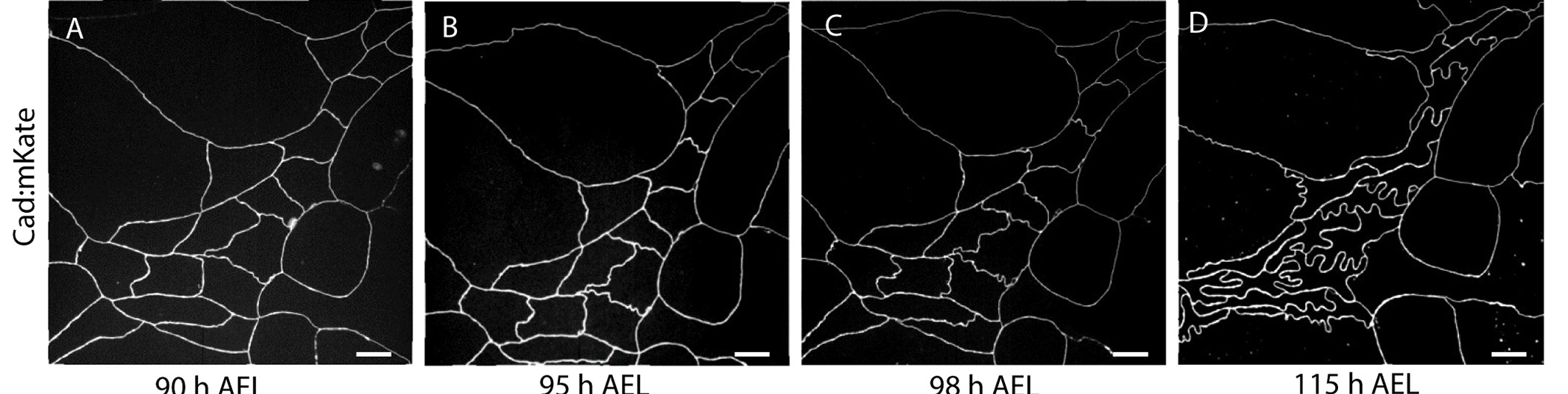
In the larval Drosophila epidermis, histoblasts remodel from a tensed polygonal network into this deeply folded geometry. The folds are not fluctuating wrinkles: they build up over many hours and then stay put.
The main conclusion is that buckling under compression can be a major driving force of morphogenesis — not only tension.
We studied this with mechanical measurements: laser ablations show that the junctions are not under tension, and optical tweezers show that they behave as elastic, interconnected structures. In collaboration with Adam Runions and Richard Smith, mechanical simulations of growing junctions in a constrained apical domain reproduce the folds. Genetic manipulations of growth link the buckling to how cells grow and pack on a limited surface.
Publications
Rigato, Meng, Charles, Runion, Abouakil, Smith, LeGoff (2024). A mechanical transition from tension to buckling underlies the jigsaw puzzle shape morphogenesis of histoblasts in the Drosophila epidermis. PLoS Biology. link