Extended depth of field super resolution
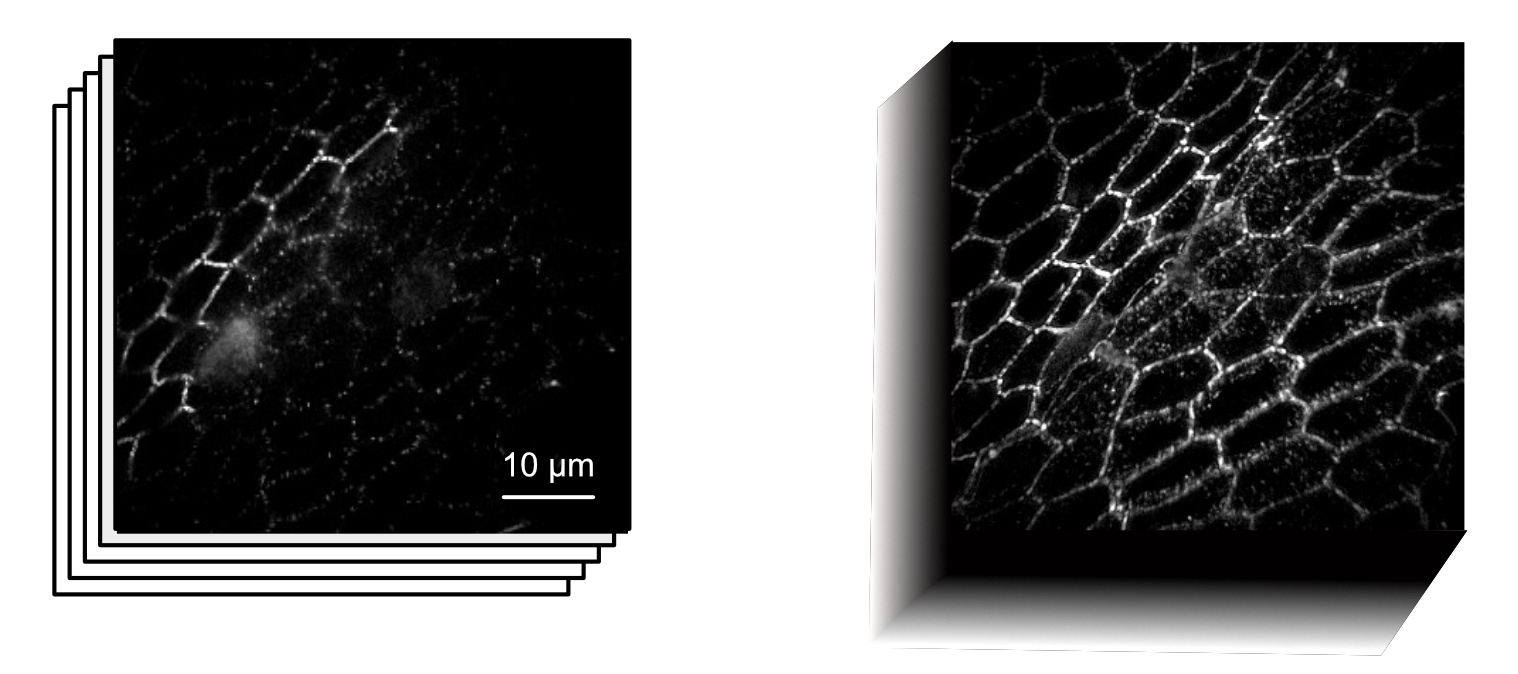
Super-resolution on large 3D samples is usually slow: each plane is acquired separately, then stacked, and live tissue takes a heavy light dose. EDF-RIM instead captures a super-resolved projection of the whole volume in a single shot.
Random illumination microscopy (RIM) uses speckle as structured illumination. The patterns are statistically robust to scattering and aberrations, which makes RIM well suited to thick tissue. Extended-depth detection then sweeps the focal plane during one camera frame, so all planes land on one image. Compared with scanning the same volume plane by plane, acquisition is about ten times faster, the light dose is lower, and the resolution stays comparable to 2D-RIM — almost twice that of conventional microscopy. For tissues organised as cell sheets, we recover the missing axial information by estimating the surface topography.
Publications
Mazzella, Mangeat, Giroussens, Rogez, Li, Creff, Saadaoui, Martins, Labouesse, Idier, Galland, Allain, Sentenac*, LeGoff* (2024). Extended-depth of field random illumination microscopy, EDF-RIM, provides super-resolved projective imaging. Light: Science & Applications. link
CNRS Ingénierie (2024). Un microscope à super-résolution pour capturer des tissus biologiques 3D en une seule image. link