Smart scanning
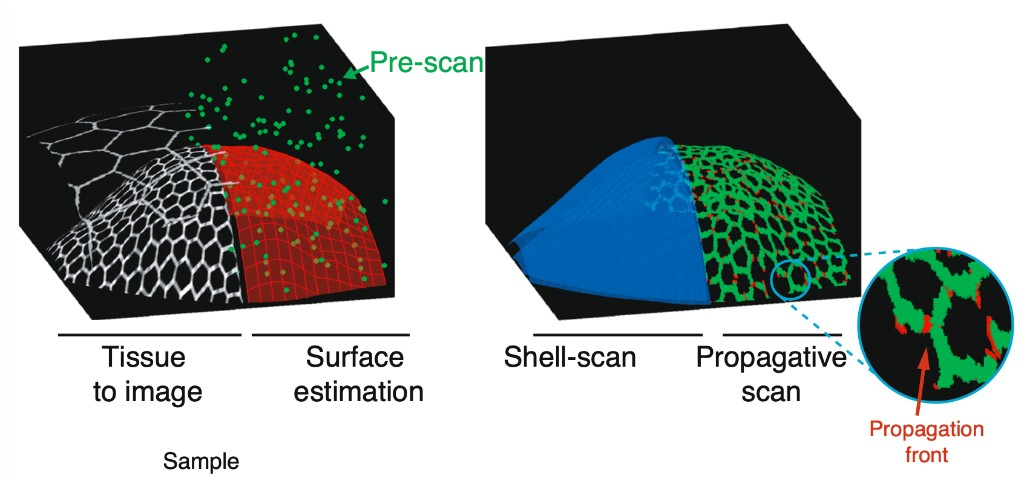
Many biological tissues, such as epithelia, form thin curved surfaces embedded in a much larger 3D volume. Conventional scanning microscopes nevertheless illuminate the entire volume, resulting in unnecessary light exposure and photobleaching.
We developed an adaptive microscope that first learns the geometry of the tissue from a sparse pre-scan and then concentrates illumination only where useful information is expected. Scanning a thin shell around the estimated surface reduces the light dose by more than 20-fold, while a second strategy that progressively follows fluorescent cell contours can reduce the scanned volume to about 1% of a conventional acquisition.
Publications
Abouakil, Meng, Burcklen, Rigneault, Galland, LeGoff (2021). An adaptive microscope for the imaging of biological surfaces. Light: Science & Applications 10, 210. link
Patents
Patent — Procédé d'acquisition d'image en deux dimensions d'un échantillon biologique à balayage ciblé : scan présomptif. Le Goff, Rigneault, Galland. FR2107819 (2021), PCTEP2022070427 (2022).
Patent — Procédé d'acquisition d'image en deux dimensions d'un échantillon biologique à balayage ciblé : scan propagatif. Le Goff, Rigneault, Galland. FR2107822 (2021), PCTEP2022070428 (2022).